What Is Protocol When Someone Has No Lawyer in Family Court in Nassau Co
| International Court of Justice | |
|---|---|
| Cour internationale de justice | |
 Seal of the International Court of Justice | |
| Established | 1945 (PCIJ dissolved in 1946) |
| Jurisdiction | Worldwide, 193 state parties |
| Location | The Hague, Netherlands |
| Coordinates | 52°05′11.8″N 4°17′43.8″Due east / 52.086611°North 4.295500°E / 52.086611; 4.295500 Coordinates: 52°05′eleven.8″N 4°17′43.8″E / 52.086611°Due north 4.295500°E / 52.086611; 4.295500 |
| Authorized past |
|
| Judge term length | 9 years |
| Number of positions | 15 |
| Website | www |
| President | |
| Currently | Joan Donoghue |
| Since | viii February 2021 |
| Vice President | |
| Currently | Kirill Gevorgian |
| Since | 8 February 2021 |
The International Courtroom of Justice (ICJ; French: Cour internationale de justice; CIJ ), sometimes known equally the Earth Court,[1] is one of the six principal organs of the United Nations (UN).[two] Information technology settles disputes between states in accord with international constabulary and gives advisory opinions on international legal issues. The ICJ is the only international court that adjudicates general disputes between countries, with its rulings and opinions serving as primary sources of international police force.
The ICJ is the successor of the Permanent Court of International Justice (PCIJ), which was established in 1920 by the League of Nations. Later on the 2d World State of war, both the League and the PCIJ were replaced by the United Nations and ICJ, respectively. The Statute of the ICJ, which sets forth its purpose and construction, draws heavily from that of its predecessor, whose decisions remain valid. All member states of the UN are party to the ICJ Statute and may initiate contentious cases; nevertheless, advisory proceedings may but be submitted past certain United nations organs and agencies.
The ICJ consists of a panel of 15 judges elected by the Un General Assembly and Security Quango for 9-year terms. No more ane judge of each nationality may be represented on courtroom at the aforementioned fourth dimension, and judges collectively must reflect the principal civilizations and legal systems of the earth. Seated in the Peace Palace in The Hague, Netherlands, the ICJ is the only principal Un organ not located in New York City.[3] Its official working languages are English and French.
Since the entry of its first case on 22 May 1947, the ICJ has entertained 179 cases through March 2021.[four]
History [edit]
The first permanent institution established for the purpose of settling international disputes was the Permanent Court of Arbitration (PCA), which was created past the Hague Peace Conference of 1899. Initiated past Russian Czar Nicholas II, the briefing involved all the world'southward major powers, likewise as several smaller states, and resulted in the offset multilateral treaties concerned with the conduct of warfare.[five] Amidst these was the Convention for the Pacific Settlement of International Disputes, which set forth the institutional and procedural framework for arbitral proceedings, which would have place in The Hague, Netherlands. Although the proceedings would exist supported by a permanent bureau—whose functions would be equivalent to that of a secretariat or court registry—the arbitrators would be appointed by the disputing states from a larger pool provided by each member of the convention. The PCA was established in 1900 and began proceedings in 1902.
A second Hague Peace Conference in 1907, which involved most of the world's sovereign states, revised the convention and enhanced the rules governing arbitral proceedings before the PCA. During this conference, the United States, Not bad Great britain and Germany submitted a joint proposal for a permanent courtroom whose judges would serve full-time. Every bit the delegates could non concord as to how the judges would be selected, the thing was temporarily shelved pending an understanding to exist adopted at a later convention.[vi]
The Hague Peace Conferences, and the ideas that emerged therefrom, influenced the creation of the Key American Courtroom of Justice, which was established in 1908 as i of the earliest regional judicial bodies. Diverse plans and proposals were fabricated between 1911 and 1919 for the establishment of an international judicial tribunal, which would non be realized into the formation of a new international system following the Beginning World State of war.
The Permanent Court of International Justice [edit]
The unprecedented bloodshed of the Start World War led to the creation of the League of Nations, established by the Paris Peace Conference of 1919 as the kickoff worldwide intergovernmental organization aimed at maintaining peace and collective security. Article 14 League's Covenant called for the establishment of a Permanent Court of International Justice (PCIJ), which would exist responsible for adjudicating any international dispute submitted to it by the battling parties, as well as to provide an informational opinion upon any dispute or question referred to it past the League of Nations.
In December 1920, post-obit several drafts and debates, the Associates of the League unanimously adopted the Statute of the PCIJ, which was signed and ratified the following yr by a majority of members. Among other things, the new Statute resolved the contentious issues of selecting judges past providing that the judges be elected past both the Council and the Assembly of the League concurrently but independently. The makeup of the PCIJ would reflect the "principal forms of civilization and the main legal systems of the world".[vii] The PCIJ would be permanently placed at the Peace Palace in The Hague, alongside Permanent Courtroom of Arbitration.
The PCIJ represented a major innovation in international jurisprudence in several ways:
- Unlike previous international arbitral tribunals, information technology was a permanent torso governed by its ain statutory provisions and rules of process
- It had a permanent registry that served as a liaison with governments and international bodies;
- Its proceedings were largely public, including pleadings, oral arguments, and all documentary prove;
- It was accessible to all states and could exist declared by states to accept compulsory jurisdiction over disputes;
- The PCIJ Statute was the beginning to list sources of law information technology would describe upon, which in plow became sources of international law
- Judges were more representative of the world and its legal systems than any prior international judicial body.
- As a permanent body, the PCIJ would, over time, make a series decisions and rulings that would develop international police
Unlike the ICJ, the PCIJ was non part of the League, nor were members of the League automatically a party to its Statute. The United States, which played a primal role in both the second Hague Peace Briefing and the Paris Peace Conference, was notably not a member of the League, although several of its nationals served as judges of the Courtroom.
From its showtime session in 1922 until 1940, the PCIJ dealt with 29 interstate disputes and issued 27 advisory opinions. The Court'due south widespread acceptance was reflected past the fact that several hundred international treaties and agreements conferred jurisdiction upon it over specified categories of disputes. In addition to helping resolve several serious international disputes, the PCIJ helped analyze several ambiguities in international constabulary that contributed to its development.
The United States played a major role in setting upward the Earth Courtroom only never joined.[8] Presidents Wilson, Harding, Coolidge, Hoover and Roosevelt all supported membership, but it was incommunicable to get a 2/3 majority in the Senate for a treaty.[9]
Establishment of the International Courtroom of Justice [edit]
Following a peak of activity in 1933, the PCIJ began to refuse in its activities due to the growing international tension and isolationism that characterized the era. The Second Globe State of war effectively put an terminate to the Courtroom, which held its concluding public session in December 1939 and issued its last orders in Feb 1940. In 1942 the United states and United Kingdom jointly alleged support for establishing or re-establishing an international court after the war, and in 1943, the U.Thousand. chaired a panel of jurists from around the world, the "Inter-Centrolineal Commission", to discuss the matter. Its 1944 report recommended that:
- The statute of any new international courtroom should be based on that of the PCIJ;
- The new court should retain an advisory jurisdiction;
- Credence of the new court'southward jurisdiction should exist voluntary;
- The court should bargain just with judicial and not political matters
Several months later, a briefing of the major Allied Powers—China, the USSR, the U.K., and the U.S.—issued a articulation declaration recognizing the necessity "of establishing at the primeval practicable date a full general international organisation, based on the principle of the sovereign equality of all peace-loving States, and open to membership by all such States, large and small, for the maintenance of international peace and security".[x]
The following Allied briefing at Dumbarton Oaks, in the United States, published a proposal in October 1944 that chosen for the institution of an intergovernmental system that would include an international court. A meeting was afterward convened in Washington, D.C. in Apr 1945, involving 44 jurists from around the earth to draft a statute for the proposed court. The draft statute was substantially like to that of the PCIJ, and it was questioned whether a new court should fifty-fifty exist created. During the San Francisco Conference, which took place from 25 Apr to 26 June 1945 and involved fifty countries, it was decided that an entirely new court should be established as a primary organ of the new United Nations. The statute of this court would form an integral part of the Un Charter, which, to maintain continuity, expressly held that the Statute of the International Courtroom of Justice (ICJ) was based upon that of the PCIJ.
Consequently, the PCIJ convened for the terminal time in Oct 1945 and resolved to transfer its archives to its successor, which would have its place at the Peace Palace. The judges of the PCIJ all resigned on 31 January 1946, with the election of the first members of the ICJ taking place the following February at the Commencement Session of the United Nations General Assembly and Security Quango. In April 1946, the PCIJ was formally dissolved, and the ICJ, in its first coming together, elected as President José Gustavo Guerrero of Republic of el salvador, who had served as the last President of the PCIJ. The Court besides appointed members of its Registry, drawn largely from that of the PCIJ, and held an inaugural public sitting later that calendar month.
The commencement instance was submitted in May 1947 by the Britain confronting Republic of albania apropos incidents in the Corfu Aqueduct.
Activities [edit]
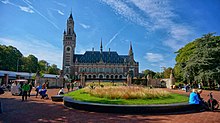
Established in 1945 by the Un Charter, the court began work in 1946 as the successor to the Permanent Courtroom of International Justice. The Statute of the International Court of Justice, similar to that of its predecessor, is the main ramble document constituting and regulating the court.[11]
The court's workload covers a broad range of judicial activity. After the court ruled that the Usa's covert war against Nicaragua was in violation of international law (Nicaragua five. Us), the Us withdrew from compulsory jurisdiction in 1986 to accept the court's jurisdiction only on a discretionary footing.[12] Chapter XIV of the United Nations Charter authorizes the UN Security Council to enforce Court rulings. However, such enforcement is field of study to the veto ability of the five permanent members of the quango, which the United States used in the Nicaragua case.[13]
Limerick [edit]
The ICJ is composed of fifteen judges elected to 9-year terms by the Un General Assembly and the UN Security Council from a list of people nominated by the national groups in the Permanent Court of Arbitration. The election process is set out in Articles four–19 of the ICJ Statute. Elections are staggered, with five judges elected every three years to ensure continuity within the court. Should a guess dice in role, the practice has generally been to elect a judge in a special election to complete the term. Judges of the International Court of Justice are entitled to the style of His/Her Excellency.
No two judges may be nationals of the same country. According to Article 9, the membership of the courtroom is supposed to represent the "primary forms of civilisation and of the principal legal systems of the world". That has meant mutual law, civil law and socialist police force (now post-communist law).
There is an informal understanding that the seats will be distributed past geographic regions so that in that location are five seats for Western countries, three for African states (including one judge of francophone civil police force, one of Anglophone common law and i Arab), ii for Eastern European states, three for Asian states and two for Latin American and Caribbean area states.[xiv] For most of the court'south history, the five permanent members of the Un Security Quango (France, USSR, Mainland china, the United Kingdom, and the The states) have always had a guess serving, thereby occupying three of the Western seats, ane of the Asian seats and one of the Eastern European seats. Exceptions have been China not having a approximate on the courtroom from 1967 to 1985, during which time it did not put forrard a candidate, and British judge Sir Christopher Greenwood being withdrawn equally a candidate for election for a 2nd nine-yr term on the bench in 2017, leaving no judges from the United Kingdom on the courtroom.[15] Greenwood had been supported past the UN Security Council but failed to become a majority in the UN Full general Assembly.[xv] Indian judge Dalveer Bhandari took the seat instead.[15]
Article 6 of the Statute provides that all judges should be "elected regardless of their nationality among persons of high moral character" who are either qualified for the highest judicial part in their home states or known as lawyers with sufficient competence in international law. Judicial independence is dealt with specifically in Articles 16–18. Judges of the ICJ are non able to concur whatever other mail or act as counsel. In practice, members of the court take their own interpretation of these rules and let them to be involved in exterior arbitration and hold professional posts as long as there is no conflict of interest. A judge tin can be dismissed only by a unanimous vote of the other members of the courtroom.[xvi] Despite these provisions, the independence of ICJ judges has been questioned. For case, during the Nicaragua instance, the The states issued a communiqué suggesting that information technology could non present sensitive material to the court because of the presence of judges from the Soviet bloc.[17]
Judges may evangelize joint judgments or give their own carve up opinions. Decisions and informational opinions are past majority, and, in the issue of an equal division, the President's vote becomes decisive, which occurred in the Legality of the Apply past a Land of Nuclear Weapons in Armed Conflict (Stance requested by WHO), [1996] ICJ Reports 66. Judges may also evangelize separate dissenting opinions.
Ad hoc judges [edit]
Article 31 of the statute sets out a procedure whereby advertising hoc judges sit on contentious cases earlier the court. The system allows whatever party to a contentious case (if it otherwise does not take one of that party's nationals sitting on the court) to select one boosted person to sit as a estimate on that case only. Information technology is thus possible that every bit many every bit seventeen judges may sit down on 1 case.
The system may seem strange when compared with domestic court processes, but its purpose is to encourage states to submit cases. For instance, if a state knows that information technology will have a judicial officer who tin can participate in deliberation and offer other judges local noesis and an understanding of the country's perspective, information technology may be more willing to submit to the jurisdiction of the court. Although this arrangement does not sit well with the judicial nature of the body, it is usually of little practical consequence. Advert hoc judges usually (simply not always) vote in favour of the state that appointed them and thus cancel each other out.[18]
Chambers [edit]
Generally, the court sits as total bench, but in the last fifteen years, it has on occasion sat every bit a bedroom. Articles 26–29 of the statute allow the court to class smaller chambers, usually 3 or 5 judges, to hear cases. Two types of chambers are contemplated by Article 26: firstly, chambers for special categories of cases, and second, the formation of ad hoc chambers to hear particular disputes. In 1993, a special chamber was established, under Commodity 26(1) of the ICJ statute, to deal specifically with environmental matters (although information technology has never been used).
Advert hoc chambers are more than ofttimes convened. For case, chambers were used to hear the Gulf of Maine Case (Canada/U.s.a.).[xix] In that case, the parties made clear they would withdraw the case unless the courtroom appointed judges to the chamber acceptable to the parties. Judgments of chambers may take either less authority than full Court judgments or diminish the proper interpretation of universal international police force informed by a variety of cultural and legal perspectives. On the other hand, the utilize of chambers might encourage greater recourse to the court and thus enhance international dispute resolution.[20]
Electric current composition [edit]
as of vi November 2021[update], the limerick of the courtroom is every bit follows:[21] [22]
| Name | Nationality | Position | Term began | Term ends |
|---|---|---|---|---|
| Abdulqawi Yusuf |  Somalia Somalia | Member | 2009 | 2027 |
| Xue Hanqin |  Prc Prc | Member | 2010 | 2030 |
| Peter Tomka |  Slovakia Slovakia | Member | 2003 | 2030 |
| Ronny Abraham |  French republic French republic | Member | 2005 | 2027 |
| Mohamed Bennouna |  Morocco Morocco | Fellow member | 2006 | 2024 |
| Antônio Augusto Cançado Trindade |  Brazil Brazil | Member | 2009 | 2027 |
| Joan Donoghue |  United states of america United states of america | Presidenta | 2010 | 2024 |
| Julia Sebutinde |  Republic of uganda Republic of uganda | Fellow member | 2012 | 2030 |
| Dalveer Bhandari |  India India | Fellow member | 2012 | 2027 |
| Patrick Lipton Robinson |  Jamaica Jamaica | Member | 2015 | 2024 |
| Hilary Charlesworth[23] (Replaced James Crawford [24]) |  Australia Australia | Fellow member | 2021 | 2024 |
| Kirill Gevorgian |  Russia Russia | Vice-Presidenta | 2015 | 2024 |
| Nawaf Salam |  Lebanese republic Lebanese republic | Member | 2018 | 2027 |
| Yuji Iwasawa |  Japan Japan | Member | 2018 | 2030 |
| Georg Nolte |  Deutschland Deutschland | Fellow member | 2021 | 2030 |
| Philippe Gautier |  Belgium Belgium | Registrar | 2019 | 2026 |
| a For the 2021–2024 term | ||||
Presidents [edit]
| # | President | Beginning | Stop | Country |
|---|---|---|---|---|
| 1 | José Gustavo Guerrero | 1946 | 1949 |  El Salvador El Salvador |
| 2 | Jules Basdevant | 1949 | 1952 | France |
| 3 | Arnold McNair | 1952 | 1955 |  United kingdom United kingdom |
| four | Green Hackworth | 1955 | 1958 | United States |
| 5 | Helge Klæstad | 1958 | 1961 |  Norway Norway |
| 6 | Bohdan Winiarski | 1961 | 1964 |  Poland Poland |
| 7 | Percy Spender | 1964 | 1967 | Australia |
| 8 | José Bustamante y Rivero | 1967 | 1970 |  Peru Peru |
| nine | Muhammad Zafarullah Khan | 1970 | 1973 |  Pakistan Pakistan |
| 10 | Manfred Lachs | 1973 | 1976 | Poland |
| 11 | Eduardo Jiménez de Aréchaga | 1976 | 1979 |  Uruguay Uruguay |
| 12 | Humphrey Waldock | 1979 | 1981 | U.k. |
| 13 | Taslim Elias | 1982 | 1985 |  Nigeria Nigeria |
| xiv | Nagendra Singh | 1985 | 1988 | India |
| 15 | José Ruda | 1988 | 1991 |  Argentina Argentina |
| 16 | Robert Jennings | 1991 | 1994 | United Kingdom |
| 17 | Mohammed Bedjaoui | 1994 | 1997 |  Algeria Algeria |
| 18 | Stephen Schwebel | 1997 | 2000 | The states |
| 19 | Gilbert Guillaume | 2000 | 2003 | France |
| 20 | Shi Jiuyong | 2003 | 2006 | Cathay |
| 21 | Rosalyn Higgins | 2006 | 2009 | Uk |
| 22 | Hisashi Owada | 2009 | 2012 | Japan |
| 23 | Peter Tomka | 2012 | 2015 | Slovakia |
| 24 | Ronny Abraham | 2015 | 2018 | French republic |
| 25 | Abdulqawi Yusuf | 2018 | 2021 | Somalia |
| 26 | Joan Donoghue | 2021 | electric current | U.s. |
Jurisdiction [edit]
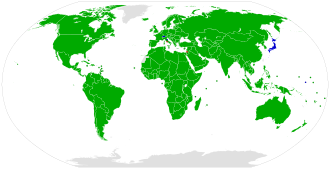
Parties upon becoming a United nations member
Parties prior to joining the UN under Article 93
Un observer states that are not parties
Every bit stated in Article 93 of the United nations Charter, all 193 Un members are automatically parties to the court'south statute.[25] Non-UN members may also become parties to the court'due south statute under the Article 93(ii) procedure, which was used by Switzerland in 1948 and Republic of nauru in 1988, prior to either joining the UN.[26] In one case a state is a political party to the courtroom'due south statute, it is entitled to participate in cases earlier the court. All the same, beingness a party to the statute does not automatically give the court jurisdiction over disputes involving those parties. The issue of jurisdiction is considered in the three types of ICJ cases: contentious issues, incidental jurisdiction, and advisory opinions.[27]
Contentious issues [edit]
Start gathering after Second World War, Dutch newsreel from 1946
In contentious cases (adversarial proceedings seeking to settle a dispute), the ICJ produces a binding ruling between states that agree to submit to the ruling of the court. Merely states may be parties in contentious cases; individuals, corporations, component parts of a federal state, NGOs, UN organs, and self-decision groups are excluded from direct participation, although the court may receive data from public international organizations. Still, this does not preclude not-state interests from existence the subject of proceedings; for example, a state may bring a instance on behalf of 1 of its nationals or corporations, such equally in matters apropos diplomatic protection.[28]
Jurisdiction is ofttimes a crucial question for the courtroom in contentious cases. The key principle is that the ICJ has jurisdiction only on the basis of consent. Nether Article 36, there are four foundations for the Court'southward jurisdiction:
- Compromis or "special agreement", in which parties provide explicit consent to the Court's jurisdiction past referring cases to it. While non truthful compulsory jurisdiction, this is perhaps the most effective jurisdictional basis, because the parties concerned have a desire for the dispute to be resolved past the Court, and are thus more likely to comply with the Court's judgment.
- Compromissory clauses in a bounden treaty. Almost modern treaties contain such clauses to provide or dispute resolution by the ICJ.[29] Cases founded on compromissory clauses have not been as effective equally cases founded on special agreement, since a state may have no interest in having the matter examined by the Court and may refuse to comply with a judgment. For instance, during the Iran earnest crunch, Iran refused to participate in a instance brought past the US based on a compromissory clause contained in the Vienna Convention on Diplomatic Relations and did not comply with the judgment.[thirty] Since the 1970s, the utilize of such clauses has declined; many modernistic treaties set out their own dispute resolution authorities, frequently based on forms of arbitration.[31]
- Optional clause declarations accepting the court'south jurisdiction. Besides known as Commodity 36(2) jurisdiction, it is sometimes misleadingly labeled "compulsory", though such declarations are voluntary. Many such declarations contain reservations that exclude from jurisdiction certain types of disputes (ratione materia).[32] The principle of reciprocity may further limit jurisdiction, as Article 36(2) holds that such announcement may be fabricated "in relation to whatever other Land accepting the same obligation...".[33] As of January 2018, seventy-four states had a annunciation in force, up from sixty-half-dozen in February 2011;[33] of the permanent Security Council members, only the United Kingdom has a annunciation.[34] In the court's early years, most declarations were made past industrialized countries. Since the 1986 Nicaragua case, declarations made by developing countries have increased, reflecting a growing confidence in the Court.[35] However, fifty-fifty those industrialized countries that have invoked optional declarations have sometimes increased exclusions or rescinded them altogether. Notable examples include the Us in the Nicaragua case, and Commonwealth of australia, which modified its announcement in 2002 to exclude disputes on maritime boundaries, about likely to prevent an impending challenge from E Timor, which gained independence ii months afterwards.[36]
- Article 36(5) provides for jurisdiction on the ground of declarations fabricated under the Statute of the Permanent Court of International Justice. Commodity 37 similarly transfers jurisdiction under any compromissory clause in a treaty that gave jurisdiction to the PCIJ.
Additionally, the court may have jurisdiction on the ground of tacit consent (forum prorogatum). In the absence of clear jurisdiction nether Article 36, jurisdiction is established if the respondent accepts ICJ jurisdiction explicitly or simply pleads on the merits. This arose in the 1949 Corfu Channel Case (U.K. 5. Albania), in which the court held that a letter of the alphabet from Republic of albania stating that it submitted to the jurisdiction of the ICJ was sufficient to grant the court jurisdiction.
Incidental jurisdiction [edit]
Until rendering a last judgment, the courtroom has competence to order interim measures for the protection of the rights of a party to a dispute. One or both parties to a dispute may apply the ICJ for issuing interim measures. In the Frontier Dispute Case, both parties to the dispute, Burkina Faso and Mali, submitted an application to the court to indicate interim measures.[37] Incidental jurisdiction of the court derives from the Article 41 of the Statute of it.[38] Such as the final judgment, the social club for interim measures of the courtroom are binding on state parties to the dispute. The ICJ has competence to indicate acting measures merely if the prima facie jurisdiction is satisfied.[ citation needed ]
Advisory opinions [edit]

An advisory opinion is a function of the court open merely to specified United Nations bodies and agencies. The UN Lease grants the General Assembly or the Security Council a power to request the courtroom to issue an advisory opinion on any legal question. Other organs of the Un rather than GA and SC may not asking an advisory stance of the ICJ unless the General Assembly authorizes them. Other organs of the United nations only request an informational opinion of the courtroom regarding the matters falling into the scope of their activities.[39] On receiving a asking, the court decides which states and organizations might provide useful information and gives them an opportunity to present written or oral statements. Advisory opinions were intended as a means past which UN agencies could seek the court'south help in deciding complex legal bug that might fall under their respective mandates.
In principle, the court'south advisory opinions are only consultative in character only they are influential and widely respected. Certain instruments or regulations can provide in advance that the advisory stance shall be specifically binding on item agencies or states, but inherently, they are non-binding nether the Statute of the Courtroom. This non-binding character does not hateful that advisory opinions are without legal effect, because the legal reasoning embodied in them reflects the court's authoritative views on important problems of international law. In arriving at them, the court follows substantially the same rules and procedures that govern its binding judgments delivered in contentious cases submitted to it past sovereign states.
An advisory opinion derives its status and authority from the fact that it is the official pronouncement of the master judicial organ of the United Nations.[40]
Advisory opinions take oftentimes been controversial considering the questions asked are controversial or the case was pursued as an indirect style of bringing what is really a contentious case before the court. Examples of advisory opinions can exist establish in the section informational opinions in the List of International Court of Justice cases commodity. 1 such well-known advisory opinion is the Nuclear Weapons Example.
Examples of contentious cases [edit]
- A complaint by the The states in 1980 that Islamic republic of iran was detaining American diplomats in Tehran in violation of international law.[41]
- A dispute between Tunisia and Great socialist people's libyan arab jamahiriya over the delimitation of the continental shelf betwixt them.[42]
- A complaint past Iran afterward the shooting down of Iran Air Flight 655 by a United States Navy guided missile cruiser.[43]
- A dispute over the course of the maritime purlieus dividing the U.South. and Canada in the Gulf of Maine area.[44]
- A complaint by the Federal Republic of Yugoslavia against the member states of the Northward Atlantic Treaty Organization regarding their actions in the Kosovo War. This was denied on xv December 2004 because of lack of jurisdiction, the FRY not being a political party to the ICJ statute at the fourth dimension it fabricated the application.[45]
- A complaint by the Republic of North Macedonia (former Yugoslav Commonwealth of Macedonia) that Greece'southward vetoing of its accretion to NATO violates the Acting Accord of xiii September 1995[46] between the two countries. The complaint was decided in favour of North Macedonia on v Dec 2011.[47]
- A complaint by the Congo-kinshasa that its sovereignty had been violated by Uganda and that the DRC had lost billions of dollars worth of resources[48] was decided in favour of the DRC.[49]
- A complaint by the Republic of India regarding a death penalty verdict against an Indian citizen, Kulbhushan Jadhav, by a Pakistani military court (based alleged espionage and destructive activities).[fifty]
Relationship with UN Security Quango [edit]
Commodity 94 establishes the duty of all UN members to comply with decisions of the courtroom involving them. If parties practice non comply, the issue may be taken before the Security Council for enforcement action. At that place are obvious problems with such a method of enforcement. If the judgment is against i of the permanent five members of the Security Quango or its allies, any resolution on enforcement would and so be vetoed. That occurred, for example, after the Nicaragua case, when Nicaragua brought the issue of the United States' noncompliance with the court's decision before the Security Council.[17] Furthermore, if the Security Council refuses to enforce a judgment confronting whatever other state, there is no method of forcing the state to comply. Furthermore, the most constructive form to take action for the Security Council, coercive action under Chapter VII of the United Nations Charter, tin be justified only if international peace and security are at stake. The Security Quango has never done that so far.[ citation needed ]
The relationship betwixt the ICJ and the Security Quango, and the separation of their powers, was considered past the court in 1992 in the Pan Am case. The court had to consider an awarding from Libya for the order of conditional measures of protection to safeguard its rights, which, it alleged, were existence infringed by the threat of economic sanctions past the United Kingdom and Usa. The problem was that these sanctions had been authorized by the Security Council, which resulted in a potential conflict between the Affiliate VII functions of the Security Council and the judicial role of the courtroom. The court decided, by eleven votes to 5, that information technology could not gild the requested provisional measures because the rights claimed by Libya, even if legitimate under the 1971 Montreal Convention, could not be prima facie regarded every bit appropriate since the action was ordered by the Security Council. In accord with Commodity 103 of the United nations Charter, obligations under the Charter took precedence over other treaty obligations. All the same, the courtroom declared the application open-door in 1998.[51] A decision on the claim has not been given since the parties (Britain, United states, and Libya) settled the example out of court in 2003.[ commendation needed ]
There was a marked reluctance on the part of a bulk of the court to become involved in a dispute in such a way as to bring it potentially into conflict with the council. The court stated in the Nicaragua example that there is no necessary inconsistency between action past the Security Council and adjudication by the ICJ. However, when there is room for conflict, the balance appears to exist in favour of the Security Quango.[ citation needed ]
Should either party neglect "to perform the obligations incumbent upon information technology nether a judgment rendered by the Court", the Security Quango may exist called upon to "make recommendations or decide upon measures" if the Security Council deems such actions necessary. In do, the courtroom'southward powers have been limited by the unwillingness of the losing party to bide by the courtroom's ruling and past the Security Council's unwillingness to impose consequences. However, in theory, "so far as the parties to the case are concerned, a judgment of the Court is binding, final and without appeal", and "by signing the Charter, a State Fellow member of the United Nations undertakes to comply with any determination of the International Court of Justice in a example to which it is a political party."[52]
For example, the United states had previously accepted the court's compulsory jurisdiction upon its creation in 1946 only in 1984, afterwards Nicaragua v. United States, withdrew its acceptance following the court's judgment that chosen on the U.s.a. to "cease and to refrain" from the "unlawful apply of strength" against the authorities of Nicaragua. The court ruled (with only the American judge dissenting) that the United States was "in breach of its obligation under the Treaty of Friendship with Nicaragua not to use forcefulness against Nicaragua" and ordered the The states to pay war reparations.[17]
Law applied [edit]
When deciding cases, the court applies international law as summarized in Commodity 38 of the ICJ Statute, which provides that in arriving at its decisions the court shall apply international conventions, international custom and the "general principles of constabulary recognized by civilized nations." It may also refer to academic writing ("the teachings of the near highly qualified publicists of the various nations") and previous judicial decisions to help interpret the constabulary although the court is non formally bound by its previous decisions under the doctrine of stare decisis. Article 59 makes articulate that the common police force notion of precedent or stare decisis does not apply to the decisions of the ICJ. The court's decision binds only the parties to that particular controversy. Under 38(ane)(d), withal, the court may consider its own previous decisions.
If the parties agree, they may also grant the court the freedom to decide ex aequo et bono ("out of equality, and for the skilful"),[53] granting the ICJ the freedom to make an equitable decision based on what is fair under the circumstances. That provision has non been used in the court's history.[ when? ] Then far,[ when? ] the International Courtroom of Justice has dealt with virtually 130 cases.
Process [edit]
The ICJ is vested with the power to brand its own rules. Court process is fix out in the Rules of Court of the International Court of Justice 1978 (equally amended on 29 September 2005).[20]
Cases before the ICJ will follow a standard pattern. The case is lodged past the bidder, which files a written memorial setting out the basis of the court'southward jurisdiction and the merits of its claim. The respondent may have the courtroom's jurisdiction and file its own memorial on the claim of the case.
Preliminary objections [edit]
A respondent that does not wish to submit to the jurisdiction of the court may enhance preliminary objections. Whatsoever such objections must be ruled upon before the courtroom can address the merits of the applicant'due south claim. Frequently, a separate public hearing is held on the preliminary objections and the court will render a judgment. Respondents unremarkably file preliminary objections to the jurisdiction of the court and/or the admissibility of the case. Inadmissibility refers to a range of arguments about factors the courtroom should have into account in deciding jurisdiction, such as the fact that the issue is not justiciable or that it is non a "legal dispute".
In addition, objections may be made considering all necessary parties are non earlier the courtroom. If the instance necessarily requires the court to rule on the rights and obligations of a state that has non consented to the court's jurisdiction, the courtroom does not proceed to effect a judgment on the merits.
If the court decides it has jurisdiction and the instance is open-door, the respondent then is required to file a Memorial addressing the merits of the applicant's claim. Once all written arguments are filed, the courtroom holds a public hearing on the merits.
Once a case has been filed, any party (usually the bidder) may seek an club from the courtroom to protect the status quo pending the hearing of the example. Such orders are known as Provisional (or Interim) Measures and are analogous to interlocutory injunctions in United States police force. Article 41 of the statute allows the courtroom to brand such orders. The court must be satisfied to take prima facie jurisdiction to hear the merits of the case earlier it grants provisional measures.
Applications to intervene [edit]
In cases in which a tertiary land's interests are affected, that state may be permitted to arbitrate in the case and participate as a full party. Under Article 62, a state "with an interest of a legal nature" may apply; however, information technology is within the court's discretion whether or non to permit the intervention. Intervention applications are rare, and the kickoff successful application occurred only in 1991.
Judgment and remedies [edit]
One time deliberation has taken identify, the court issues a majority stance. Individual judges may effect concurring opinions (if they concord with the event reached in the judgment of the courtroom but differ in their reasoning) or dissenting opinions (if they disagree with the bulk). No appeal is possible, merely any party may enquire for the court to clarify if there is a dispute as to the significant or telescopic of the court's judgment.[54]
Criticisms [edit]
The International Court has been criticized with respect to its rulings, its procedures, and its authority. Equally with criticisms of the United Nations, many critics and opponents of the Court refer to the general dominance assigned to the body by member states through its Charter, rather than to specific issues with the limerick of judges or their rulings. Major criticisms include the following:[55] [56] [57]
- "Compulsory" jurisdiction is limited to cases where both parties have agreed to submit to its decision, and so instances of aggression tend to exist automatically escalated to and adjudicated by the Security Council. According to the sovereignty principle of international law, no nation is superior or inferior confronting another. Therefore, there is no entity that could force the states into exercise of the law or punish u.s.a. in instance whatsoever violation of international police force occurs. Therefore, the absence of bounden forcefulness means that the 193 member states of the ICJ do not necessarily accept to accept the jurisdiction. Moreover, membership in the Un and ICJ does not give the courtroom automatic jurisdiction over the member states, just information technology is the consent of each state to follow the jurisdiction that matters.
- The International Court of Justice cannot hear the cases of organizations, private enterprises, and individuals. Furthermore, Un agencies are unable to raise a example except in the circumstance of a not-binding informational opinion. The national states are the only ones who are able to bring cases for and human activity as defendants for these individuals. Equally a result, victims of war crimes, crimes against humanity and minority groups may not have the support of their national country.
- Other existing international thematic courts, such every bit the ICC, are not under the umbrella of the International Court. Unlike ICJ, international thematic courts like ICC work independently from United Nations. Such dualistic structure between various international courts sometimes makes it difficult for the courts to engage in constructive and collective jurisdiction.
- The International Court does not savour a full separation of powers, with permanent members of the Security Quango existence able to veto enforcement of cases, even those to which they consented to be leap.[58] Because the jurisdiction does non have binding force itself, in many cases, the instances of aggression are adjudicated by Security Council past adopting a resolution, etc. In that location is, therefore, a likelihood for the permanent member states of Security Council to avoid the legal responsibility brought up by International Courtroom of Justice, as shown in the example of Nicaragua 5. United states of america.[59]
- The Court has been accused of judicial parsimony, with its rulings disposed to dismiss submissions of parties on jurisdictional grounds and non resolving the underlying dispute between them.[60]
See besides [edit]
- International Criminal Court
- International Criminal Tribunal for Rwanda
- International Criminal Tribunal for the onetime Yugoslavia
- International Tribunal for the Law of the Sea
- List of treaties that confer jurisdiction on the International Court of Justice
- Provisional measure of protection
- Supranational aspects of international organizations
- Universal jurisdiction
References [edit]
- ^ Nations, United. "International Courtroom of Justice". United Nations . Retrieved 29 August 2020.
- ^ Koh, Steven Arrigg (27 Baronial 2014). "4 Things You lot Should Know Almost The Hague". HuffPost . Retrieved 17 March 2017.
- ^ "The Court". world wide web.icj-cij.org. Archived from the original on 10 January 2018. Retrieved 10 January 2018.
- ^ "Cases". www.icj-cij.org . Retrieved 29 August 2020.
- ^ Scott, James Brown. "The Hague peace conferences of 1899 and 1907; a series of lectures delivered before the Johns Hopkins University in the yr 1908". avalon.law.yale.edu . Retrieved two May 2019.
- ^ Eyffinger, Arthur (2007). "A Highly Disquisitional Moment: Role and Record of the 1907 Hague Peace Briefing". Netherlands International Law Review. 54 (2): 197. doi:x.1017/S0165070X07001970. S2CID 144726356.
- ^ "History | International Court of Justice". www.icj-cij.org . Retrieved 3 May 2019.
- ^ Accinelli, Robert D. (1978). "The Roosevelt Administration and the World Court Defeat, 1935". The Historian. 40 (iii): 463–478. doi:10.1111/j.1540-6563.1978.tb01903.10. JSTOR 24445043.
- ^ doi:10.7202/030751a
- ^ "The Moscow Conference, October 1943". avalon.police force.yale.edu . Retrieved 3 May 2019.
- ^ Statute of the International Court of Justice Archived 29 June 2011 at the Wayback Machine. Retrieved 31 August 2007.
- ^ Churchill, Ward. A Little Affair of Genocide. San Francisco: Urban center Lights Books, 1997. Print.
- ^ "United Nations Official Document". www.united nations.org.
- ^ Harris, D. Cases and Materials on International Law, seventh ed. (2012, London) p. 839.
- ^ a b c "International Court of Justice: UK abandons bid for seat on Un bench". BBC. Retrieved 21 November 2017.
- ^ ICJ Statute, Article 18(one)
- ^ a b c Case Concerning Military and Paramilitary Activities in and Against Nicaragua (Nicaragua 5 USA), [1986] ICJ Reports 14, 158–threescore (Merits) per Judge Lachs.
- ^ Posner, E. A., and De Figueiredo, Yard. F. P. (June 2005). "Is the International Court of Justice Biased?" (PDF). Journal of Legal Studies. University of Chicago. 34.
{{cite periodical}}: CS1 maint: uses authors parameter (link) - ^ Rules of Courtroom of the International Court of Justice 1978 Archived 26 November 2005 at the Wayback Car (as amended on five Dec 2000). Retrieved 17 Dec 2005. See also Practice Directions I-XII Archived 27 November 2005 at the Wayback Motorcar (as at 30 July 2004). Retrieved 17 December 2005.
- ^ a b Schwebel Due south "Ad Hoc Chambers of the International Court of Justice" (1987) 81 American Journal of International Police force 831.
- ^ "Electric current Members | International Court of Justice". www.icj-cij.org. Archived from the original on 29 November 2017. Retrieved 16 April 2021.
- ^ "General Associates, in Second Secret Ballot Round, Elects Five Judges to Serve Nine-Twelvemonth-Long Terms on International Court of Justice | Meetings Coverage and Printing Releases". world wide web.un.org. United nations News Centre. 12 November 2020. Retrieved xvi April 2021.
- ^ "Veteran Australian gauge Hilary Charlesworth elected to the International Court of Justice". UN News. 5 Nov 2021. Retrieved 6 November 2021.
- ^ "It is with neat sadness that the Courtroom announces the passing of H.Eastward. Guess James Richard Crawford" (PDF). International Court of Justice. 31 May 2021. Retrieved 3 June 2021.
- ^ "Chapter 14 | United Nations". United nations . Retrieved 21 November 2017.
- ^ "Chapter I - Lease of the Un and Statute of the International Court of Justice: 3 . Statute of the International Court of Justice". United Nations Treaty Serial. 9 July 2013. Retrieved nine July 2013.
- ^ J. G. Merrills (2011). International Dispute Settlement . New York: Cambridge University Press. pp. 116–134. ISBN978-0521153393.
- ^ See the Nottebohm Case (Liechtenstein v Republic of guatemala), [1955] ICJ Reports 4.
- ^ Run into Listing of treaties that confer jurisdiction on the ICJ.
- ^ Case Concerning United States Diplomatic and Consular Staff in Tehran (USA v Iran), [1979] ICJ Reports vii.
- ^ Run into Charney J "Compromissory Clauses and the Jurisdiction of the International Court of Justice" (1987) 81 American Journal of International Police force 855.
- ^ See Alexandrov Due south Reservations in Unilateral Declarations Accepting the Compulsory Jurisdiction of the International Courtroom of Justice (Leiden: Martinus Nijhoff, 1995).
- ^ a b "Declarations recognizing the jurisdiction of the Court as compulsory | International Court of Justice". www.icj-cij.org . Retrieved 30 May 2021.
- ^ For a complete list of countries and their opinion with the ICJ, see Declarations Recognizing as Compulsory the Jurisdiction of the Court Archived 29 June 2011 at the Wayback Machine. Retrieved 21 February 2011.
- ^ Cesare P.R. Romano, INTERNATIONAL JUSTICE AND DEVELOPING COUNTRIES (Connected): A QUALITATIVE Analysis, The Law and Practise of International Courts and Tribunals 1: 539–611, 2002. 2002 Kluwer Law International. Printed in holland., pp. 575-576. "Over the decades, developing countries accept significantly changed their attitudes toward the ICJ, to the signal that while their participation accounted for 50% of the contentious cases filed in the 1960s, in the 1990s they were the source of 86% of the cases"
- ^ Burton, Bob (17 May 2005). Australia, East Timor strike oil, gas bargain. Asia Times. Retrieved 21 Apr 2006.
- ^ "Conditional measures are indicated in the case of the Borderland Dispute" (PDF). Archived from the original (PDF) on 9 Dec 2017.
- ^ "Statute of the Court | International Court of Justice". world wide web.icj-cij.org. Archived from the original on 7 March 2018. Retrieved 2 November 2017.
- ^ "Chapter XIV". www.un.org . Retrieved 3 November 2017.
- ^ Pieter H.F. Bekker (12 December 2003). "The United nations General Assembly Requests a World Court Advisory Opinion on Israel's Separation Barrier". American Society of International Law. Retrieved 21 November 2017.
- ^ "Reports of Judgments, Advisory Opinions and Orders" (PDF). International Court of Justice. 24 May 1980. Archived from the original (PDF) on 1 December 2017. Retrieved 21 November 2017.
- ^ "Application for Revision and Estimation of the Judgment of 24 February 1982 in the Example Concerning the Continental Shelf (Tunisia/Libyan Arab Jamahiriya)" (PDF). International Court of Justice. 10 December 1985. Archived from the original (PDF) on 11 January 2012.
- ^ "Aerial Incident of 3 July 1988 (Islamic Republic of Iran five. Us of America)". International Court of Justice. 17 May 1989. Retrieved 9 February 2021.
- ^ "Case Concerning Delimitation of the Maritime Boundary in the Gulf of Maine Area (Canada/The states)" (PDF). International Court of Justice. 12 Oct 1984. Archived from the original (PDF) on i December 2017. Retrieved 21 November 2017.
- ^ "International Court of Justice". Icj-cij.org. Archived from the original on 3 February 2014. Retrieved 2 Feb 2014.
- ^ "Interim Accord" (PDF). 13 September 1995. Archived from the original (PDF) on 25 March 2009.
- ^ "The Courtroom finds that Greece, past objecting to the access of the former Yugoslav Macedonia to NATO, has breached its obligation nether Article 11, paragraph one, of the Interim Accord of xiii September 1995" (PDF). The International Courtroom of Justice. 5 December 2011. Archived from the original (PDF) on 16 July 2017. Retrieved 2 February 2014.
- ^ "Armed Activities on the Territory of the Congo (Democratic Republic of the Congo v. Republic of uganda) Archived 27 February 2018 at the Wayback Machine". Icj-cij.org.
- ^ "Court orders Uganda to pay Congo damages". The Guardian. 20 Dec 2005
- ^ "Kulbhushan Jadhav: Kulbhushan Jadhav latest news, photos & videos". The Times of Republic of india.
- ^ "Questions of Interpretation and Application of the 1971 Montreal Convention arising from the Aerial Incident at Lockerbie (Libyan Arab Jamahiriya 5. United States of America), Preliminary Objections, International Courtroom of Justice, 27 Feb 1998". Icj-cij.org. Archived from the original on 12 May 2012. Retrieved 4 November 2011.
- ^ "Chapter XIV". www.united nations.org. 17 June 2015. Retrieved 1 June 2020.
- ^ Statute of the International Court of Justice, Article 38(2)
- ^ Statute of the International Court of Justice, Commodity lx
- ^ Ogbodo, S. Gozie (2012). "An Overview of the Challenges Facing the International Court of Justice in the 21st Century". Annual Survey of International & Comparative Law. 18 (1): 93–113. Retrieved 6 June 2016.
- ^ Suh, Il Ro (April 1969). "Voting Behavior of National Judges in International Courts". The American Periodical of International Police force. 63 (two): 224–236. doi:x.2307/2197412. JSTOR 2197412. S2CID 147317419.
- ^ William, Samore (1956). "National Origins five. Impartial Decisions: A Study of World Court Holdings". Chicago-Kent Law Review. 34 (3): 193–222. ISSN 0009-3599. Retrieved 6 June 2016.
- ^ "Globe Court: Completing the Circle". Time. 28 November 1960. Archived from the original on viii October 2010. Retrieved iv November 2011.
- ^ David TUYISHIME, Critical Analysis on the Ineffectiveness of the ICJ in the Settlement of Disputes between States: The Instance of Nicaragua Case, E-Journal of Law, Vol 3 (1) 2017.
- ^ Hernandez, G. I. (2013). "A Reluctant Guardian: The International Court of Justice and the Concept of 'International Community'". British Yearbook of International Police force. 83: 13–60. doi:10.1093/bybil/brt003.
Further reading [edit]
- Accinelli, R. D. "Peace Through Law: The Us and the World Court, 1923-1935". Historical Papers / Communications historiques, 7#1 (1972) 247–261. doi:x.7202/030751a.
- Bowett, D W. The International court of justice : procedure, practice and procedure (British Constitute of International and Comparative Law: London, 1997).
- Dunne, Michael. "Isolationism of a Kind: Two Generations of World Court Historiography in the United states," Journal of American Studies (1987) 21#3 pp 327–351.
- Kahn, Gilbert Northward. "Presidential Passivity on a Nonsalient Event: President Franklin D. Roosevelt and the 1935 Globe Court Fight." Diplomatic History 4.2 (1980): 137–160.
- Kolb, Robert, The International Court of Justice (Hart Publishing: Oxford, 2013).
- Patterson, David S. "The United States and the origins of the globe court". Political Science Quarterly 91.ii (1976): 279–295. JSTOR 2148413.
- Rosenne, South., Rosenne'southward the globe courtroom: what it is and how it works (6th ed.). Leiden: Martinus Nijhoff, 2003.
- Van Der Wolf W. & De Ruiter D., "The International Court of Justice: Facts and Documents Near the History and Work of the Court" (International Courts Association, 2011)
- Wilde, Ralph; Charlesworth, Hilary; Schrijver, Nico; Krisch, Nico; Chimni, B. Due south.; Gowlland-Debbas, Vera; Klabbers, Jan; Yee, Sienho; Shearer, Ivan (11 December 2011). "Un Reform Through Practice: Report of the International Law Association Study Group on United Nations Reform". SSRN 1971008.
- Yee, Sienho. "Commodity 38 of the ICJ Statute and Applicative Police force: Selected Issues in Contempo Cases", Journal of International Dispute Settlement 7 (2016), 472–498.
- Zimmermann, Andreas; Christian Tomuschat, Karin Oellers-Frahm & Christian J. Tams (eds.), The Statute of the International Courtroom of Justice: A Commentary (second. ed. Oct 2012, Oxford University Press).
External links [edit]
- Official site
- ICJ Multimedia Gallery (photos, videos, webstreaming)
- List of cases ruled upon by the ICJ since its creation in 1946
- Peace Palace Library - ICJ Research Guide
- The Statute of the International Courtroom of Justice on the United Nations AVL: summary of the procedural history, list of selected preparatory documents and audiovisual material related to the negotiations and adoption of the Statute.
- International Criminal Court : Run across also, a tribunal to prosecute individuals for genocide, crimes against humanity, war crimes, and the crime of aggression
- CIJ ICJ: International Courtroom of Justice on Youtube
Lectures [edit]
- The ICJ in the Service of Peace and Justice, Conference organized on the Occasion of the Centenary of the Peace Palace
- Lecture by Awn Shawkat Al-Khasawneh entitled "Reflections on the Jurisdiction of the International Court of Justice" in the Lecture Series of the United nations Audiovisual Library of International Law
- Lecture past Mohamed Bennouna entitled "La Cour internationale de Justice, juge des souverainetés?" in the Lecture Series of the United Nations Audiovisual Library of International Law
- Lecture past Philippe Couvreur entitled "La Cour internationale de Justice" in the Lecture Series of the United Nations Audiovisual Library of International Law
- Lecture past Vera Gowlland-Debbas entitled "The International Court of Justice as the Principal Judicial Organ of the United nations" in the Lecture Series of the United nations Audiovisual Library of International Law
- Lecture by Mariko Kawano entitled "Some Salient Features of the Gimmicky International Disputes in the Precedents of the International Court of Justice" in the Lecture Series of the United Nations Audiovisual Library of International Law
- Lecture by Mariko Kawano entitled "International Courtroom of Justice and Disputes Involving the Interests of Third Parties to the Proceedings or the Mutual Interests of the International Community equally a Whole or of the Community Established by a Convention" in the Lecture Series of the United Nations Audiovisual Library of International Police
- Lecture by Edward McWhinney entitled "Judicial Activism and the International Courtroom of Justice" in the Lecture Series of the United Nations Audiovisual Library of International Law
- Lecture by Alain Pellet entitled "Conseil devant la Cour internationale de Justice" in the Lecture Series of the United nations Audiovisual Library of International Law
- Lecture by Jiuyong Shi entitled "The Present and Future Office of the International Court of Justice in the Peaceful Settlement of International Disputes" in the Lecture Series of the United Nations Audiovisual Library of International Law
bissettplacrour84.blogspot.com
Source: https://en.wikipedia.org/wiki/International_Court_of_Justice
0 Response to "What Is Protocol When Someone Has No Lawyer in Family Court in Nassau Co"
Postar um comentário